

A live event readout from Linksbridge Pharma News
July 31, 2026
The changing dynamics have implications for global health actors whose work intersects with industry partners.
Those were the takeaways from a mid-July panel discussion at the Gates Foundation’s headquarters in Seattle. Coproduced by Linksbridge SPC and the foundation, the event brought together Gates Foundation Senior Advisor Isabel Torres, Senior Officers Lesley Edwards and Amandeep Madra, and Linksbridge Editorial Director Josh Axelrad to explore what’s changing in the industry and why it matters. It was the kickoff to Pharma in Focus, a bimonthly series the foundation will be hosting into next year.
A sizable chunk of existing pharma revenue faces loss-of-exclusivity exposure by 2030—over $230 billion, according to IQVIA—but, as the panelists emphasized, the oft-discussed “patent cliff” is hardly novel. It’s an inherent, recurring component of an industry built on patented drugs whose sales tend to plummet when generics become available. What’s new this time: the U.S. pricing tailwinds that have historically helped the industry recover from its patent difficulties are less reliable.
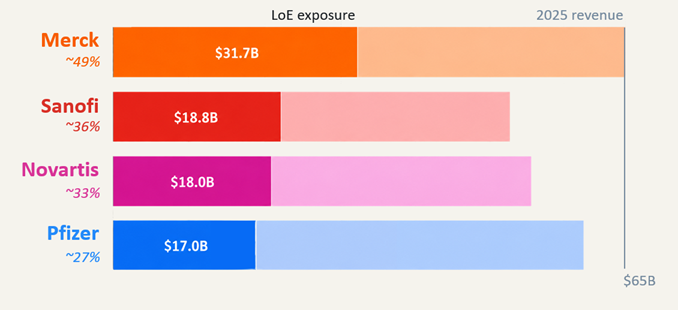
Merck stands to lose almost half its 2025 revenue when Keytruda and other products lose exclusivity. Source: Linksbridge
The Trump administration’s “Most Favored Nation” (MFN) drug-pricing policy has added new uncertainty to pharma revenue. MFN aims to link U.S. drug prices to prices in a selection of peer countries through mechanisms including new payment models for federal drug programs and a series of confidential deals—17 at last count—between drugmakers and government. These agreements reportedly exempt participating companies from U.S. tariff threats in exchange for pricing and other concessions, but the details are opaque.
Some evidence suggests MFN is more bluster than bulldozer: Pfizer’s stock gained a jaw-dropping 14% in the two days following word of its agreement with the U.S., for example, implying an optimistic take on the part of investors. Nonetheless, there are signs the policy is slowing drug launches in peer countries—and an AstraZeneca executive claimed this week that the company’s pricing strategy for new launches “has really evolved” due to MFN.
What does this mean for global health? An industry uncertain of its sales outlook may have less leeway to partner on global health initiatives that show few signs of a financial return.
The tide seems to be turning on environmental, social and governance (ESG) frameworks. When it began to take shape in the early 2000s, ESG was seen as a way to measure and incentivize responsible corporate performance in areas beyond sales and profits. For global health stakeholders, the opportunity was intriguing: with a growing number of investors and asset managers prioritizing companies with strong ESG marks, drugmakers might see an incentive to up their commitments to global health goals. The Access to Medicine Foundation made just this argument when publishing its inaugural index: “The Index will enable pharmaceutical companies to visibly increase their ESG performance and become more attractive to ESG-conscious investors,” its 2008 ranking of access performance stated.
In 2026, the momentum is changing. Investors are less focused on ESG. The number of ESG fund closures began to outpace fund launches in 2023, according to Morningstar—a trend that accelerated last year. The Trump administration is also playing a role, pressuring proxy advisor firms on ESG, moving to limit shareholder resolutions on ESG-related matters, and attempting to influence the private sector—including pharma—to quash diversity, equity and inclusion efforts. Multinational pharma players from GSK to Pfizer to Novartis and Roche have fallen in line.

Gates Foundation headquarters in Seattle. Photo by Claudia Mendez M. / Adobe Stock
Panelists reflected on multiple transformations underway in the pharma business model:
The Trump administration has slashed investments in mRNA vaccines and basic science, with long-term repercussions for biopharma R&D and future pipelines. Meanwhile, changes in vaccine recommendations from U.S. health officials are squeezing sales: Pfizer attributed a 59% drop in Covid-19 vaccine sales from Q1 2025 to Q1 2026 in part to “lower utilization in the U.S. primarily resulting from a narrower recommendation for vaccination.” For 2026, Merck’s HPV vaccine sales are projected to fall $315 million–$630 million after changes to the U.S. childhood vaccine schedule.
The combination of financial pressure, the diminishing influence of ESG, and heightened uncertainty may mean global health engagement will hinge more than ever on convincing business logic. Levers include developing evidence of mid- to long-term growth opportunities in low- and middle-income countries, focusing on dual-market products (for example, in the women’s health space), and working to expand the visibility and impact of R&D incentives, such as Priority Review Vouchers.
The panel also noted that industry developments can bring positive surprises as well as daunting ones. Almost no one would’ve predicted a year or two back that Lilly would make significant investments in infectious diseases. Yet in May of this year, the company spent nearly $4 billion to buy a trio of vaccine makers—reportedly its biggest vaccine play since ramping up IPV production in the mid-1950s. The intersection between global health and industry is shifting, but it’s not static. And that leaves room for attentiveness, creativity and new solutions.
SUBSCRIBE TO LINKSBRIDGE PHARMA NEWS


